Blame this on the sun!
But switch on the T.V and you'll find a long long line of ads for deos. All of which will have in-your-face, cringe-inducing shots of pretty/hunky movie stars flashing their underams as they spray on the deodorant that'll apparently keep them smelling of roses 24 x 7.
There's the dishy John Abraham and his Garnier. There's the svelte Asin and the effervescent Genelia. And...you get the point?
I guess raising you arms above your head and flashing your underarms with abandonment is perfectly acceptable nowadays. I'm sure to be labelled old-fashioned if I crib too much about this.
But I grew up in a time when underarms were called armpits. Not without reason. They were meant to be hidden, like all pits. Or at least lowered. Of course we saw lots of men and women wearing sleeveless clothing, including almost all of my family members. But that did not mean they jumped about raising their arms all the time.
In fact, when my brother started going to school, he was so enamoured of his Kindergarten teacher, Miss Joshi, who always wore dainty sleeveless blouses (with saris, that is), that he cried and cried and finally persuaded my Maa to switch over to sleeveless blouses, just like "Aunty Joshi". And my Maa was converted for life.
So you see, I'm not ethically anti-underarms. In fact, I wear a fair amount of sleeveless stuff myself - although my fat upper-arms demoralise my endeavours quite often.
My objection is aesthtic. Male or female, sweaty or fragrant, toned or not, polished or not (beauty parlours often have a service called UNDERARM POLISHING that I'm rather curious about), depilated or not, I still believe underarms are best lowered if they are uncovered.
Of course, if they are covered, you can merrily go about raising them and doing your own thing - like shouting slogans and picketing. I'm a Bengali from the land of the Red Comrades and the Red-faced-because-she's-mostly-shouting Mamata Banerjee, so I've met millions of raised and angry and protesting underarms. But they are covered.
WHAT DO YOU THINK?
Showing posts with label school. Show all posts
Showing posts with label school. Show all posts
Thursday, June 3, 2010


Thursday, March 4, 2010
TEDDY BEAR TEDDY BEAR, OFF TO SCHOOL

My two teddy-bear-cubs (my daughters) go to school in a big yellow school-bus. In fact, when the younger one went to play-school, which was just around the corner, she refused to accept that it was a PROPER SCHOOL. Because there was no sunny yellow school bus full of bright, chattering children to take her there.
Neither had we. We went to school in a rickety cycle-rickshaw. Our school-special rickshaw was value-added with a narrow wooden bench tied carefully to the back of the driver's seat. This way, it could carry many more children than it would have done unadorned! The rickshaw can carry two people in relative - if rather bumpy - comfort. With the added bench, it was made to carry 7-8 children. I've tried to re-create the engineering in my mind, but the mind BOGGLES (I'm currently immersed in the world of Jeeves, so I just had to put in that word) at the effort.
Our rickshaw-driver an affable gent called, for some unfathomable reason, Jamaibabu (son-in-law). Every morning, at around eight, the punctual Jamaibabu would come ponk-ponking the rickshaw horn at our gate. Rushing out, my brother and I would hop on to the coir-cushioned back-rest-ed seats. As our house was the first place Jamaibabu halted at, it was rather easy for us to get the best seats, which we ruthlessly refused to move away from, even if the others requested.
Jamaibabu pulled the rickshaw - with the familiar kaanch-konch sound of the three wheels turning - along the winding lanes, halting at other houses and picking up...Dipto and Rumni from their mansion with the flower-fragrant garden, Bapi from the dilapidated rented house, another very formal-looking child (whom we called Mr Gon, because he carried a tin suitcase with MR. S. GON printed on it; he was always late as his mother pleaded and pestered him to finish his glass of milk), and my cousin J and her brother.
The seats filled up fast and we sat face-to-face, three in the original rickshaw seat and five clinging like limpets to the narrow wooden bench. Knees knocked together and bags knocked over others' as Jamaibabu hit the pedal hard (we always blamed the tardy Mr Gon and his hapless mother for this). Fights sometimes erupted, but even without arguing, our decibel level was pretty high. The genial Jamaibabu would sometimes turn his head to admonish us, making the rickshaw wobble scarily. The kaanch-konch of the wheels increased as the rickshaw bumped and bounced its way to Modern School like an overloaded ark full of chattering, chirpy children. Although Jamaibabu had probably never heard of time-management, we were almost never late.
And in the afternoon, the rickshaw would return, bursting at the seams with rather exhausted but still noisy children. Bagging seats was a free-for-all, and getting a good seat (which somehow was more important on the return journey, maybe our tender bottoms were sore after all that sitting around) meant making a dash from the school-gate to the waiting rickshaw. As Jamaibabu shooed us on and hustle-pedalled his way home, the discomfort became negligible in the delight of chatter-boxing!
HOW DID YOU GO TO SCHOOL?
Tuesday, September 1, 2009
OUTSIDE THE SCHOOL GATES
Nowadays our children have their school tiffins from healthy, sanitized lunch boxes, or from dietician-supervised school canteens. But in our unhygienic and un-health-conscious childhood, we would be allowed a once-a-week (or more, if we spent judiciously) indulgence of scandalously-unhealthy treats which tempted us just outside the school gates.
There was the phuckha-churmur-wallah and the alu-kabli-wallah (both selling sour-and-spicy snacks of chick-pea, potato, onion, tamarind, chilli powder and god-only-knows-what-else) with their fiery wares which drew us in droves as we slurped, gobbled, licked our fingers, wiped our eyes, hung out our burning tongues, and rubbed our runny noses. My older cousins often teased us and said that the dirtier the phuchka-wallah, the tastier would be his wares. The dirt of his hands (and elsewhere?) was the secret ingredient behind his mouth-watering (and eyes-and-nose-watering) recipes. But being gastronomic bravehearts, we were not deterred by such trifling rumours, and gulped down the gruesome grub to our heart's content.
There was the hajmi-churanwallah selling numerous dark and dangerous looking hajmis (supposedly-digestive-aids) and aachars (pickles) of ancient pedigree. He was such a great favourite of mine that for a long time I fantasised about marrying his son (he himself was nearing seventy), and living amidst a treasure trove of unending supplies of amshi (dried mango pickle) and kuler achar (berry pickle).
And then, there was the cake-wallah who would take down the black tin trunk which he carried atop his dirty turban, squat on the ground and open it in front of our eager eyes. Inside that plain black trunk (on which his initials would be painted in white block caps), would be a magical bonanza of colourful pastries (which we called 'cakes' in those pre-Monjinis days). The colours would be dubiously lurid, and the cakes themselves were suspiciously stale, but who cared? The crayon-pink and neon-green, and the rather more expensive brittle-brown (which cost more because it was claimed to be chocolate) coated confectionary was regarded as a coveted special treat by us, reserved for celebrations like birthdays or sports-days or result-and-promotion-days or you-are-my-best-friend-from-now-on-days.
After school, we would burst out of the confining school gates, a chattering-clattering-clamouring flock, with disheveled uniforms and inky faces, gathering in noisy, demanding groups around these treat-sellers, who dispensed dirt and deliciousness in equal degree.
WHO TEMPTED YOU WITH IRRESISTABLE TEMPTATIONS OUTSIDE YOUR SCHOOL GATE?
Friday, July 24, 2009
A STITCH IN TIME…
In school, we had a subject called SUPW (Socially Useful Productive Work). It involved a lot of craft-related activities, and, later in senior school, some social project work. Being lazy and self-absorbed children, we dismissed the subject as Some Useful Periods Wasted.
I did not really mind wasting the period by making pencil-holders by wrapping colourful paper around old talcum powder tins, and other fanciful and useless things like making prints with cut slices of ladies’ fingers (the vegetable) and onion-halves.
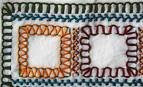
What irked and bothered me was the compulsory sewing projects we girls had to undertake. I remember we had a lady teacher teaching us the subject for a few years, who would insist on all the girls sitting and learning various kinds of stitches. The boys, lucky idiots, were spirited away to some unspecified location, where they made unrecognizable clay models and wood-carvings.
I did not really mind wasting the period by making pencil-holders by wrapping colourful paper around old talcum powder tins, and other fanciful and useless things like making prints with cut slices of ladies’ fingers (the vegetable) and onion-halves.
What irked and bothered me was the compulsory sewing projects we girls had to undertake. I remember we had a lady teacher teaching us the subject for a few years, who would insist on all the girls sitting and learning various kinds of stitches. The boys, lucky idiots, were spirited away to some unspecified location, where they made unrecognizable clay models and wood-carvings.

We were stuck in the classroom with the needle often stuck in our fingers (especially in my hands, which seemed to be all thumbs). The simple run stitch seemed deceptively easy and my fingers would run away merrily with the needle, till the stern teacher would look over my shoulder and point out the unnecessary necessity of each stitch being of the same size and equidistant from one another. 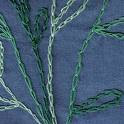

The stem stitch and chain stitch were all right, I suppose, if you overlooked the variously sized links of the chain, or bits of the stem. The criss-cross herringbone always made me cross, although I enjoyed the neatly laid-out patterns of the cross stitch where I had only to follow the design laid out on the graph and where the stitches would automatically be of the same size, because the cloth itself was woven like a grid.
But I was completely flummoxed by the really intricate stuff like the neat hem stitches, buttonhole-stitches (my holes looked as if they had been forced by a particularly belligerent big button), French knots and the tiny satin stitches. I was really really bad at the fine art of needle craft, which was fairly surprising because both Maa (mother) and Didia (my cousin) spent long hours discussing patterns and colours and creating delicate gossamer embroidery on many of our dresses. Unfortunately, my admiration did not progress to emulation, and I remained handicapped at handicraft.
And so, I breathed a huge sigh of relief when the stern sewing mistress left our school and was replaced by the affable Maity Sir, who taught both Bengali and SUPW. I put away the handkerchiefs with the uneven half-finished hems, and the round wooden embroidery frame and VIBGYOR silk threads. And happily spent the rest of my SUPW periods making unproductive and silly stuff like soap-gardens (where you had to stick paper flowers and leaves on wires into the soap and make a fancy fence-border with pins and garish plastic ribbons). Horribly tacky stuff, but easier to tackle than sewing.
DO SEW A MEMORY TO THIS POST.


The stem stitch and chain stitch were all right, I suppose, if you overlooked the variously sized links of the chain, or bits of the stem. The criss-cross herringbone always made me cross, although I enjoyed the neatly laid-out patterns of the cross stitch where I had only to follow the design laid out on the graph and where the stitches would automatically be of the same size, because the cloth itself was woven like a grid.

But I was completely flummoxed by the really intricate stuff like the neat hem stitches, buttonhole-stitches (my holes looked as if they had been forced by a particularly belligerent big button), French knots and the tiny satin stitches. I was really really bad at the fine art of needle craft, which was fairly surprising because both Maa (mother) and Didia (my cousin) spent long hours discussing patterns and colours and creating delicate gossamer embroidery on many of our dresses. Unfortunately, my admiration did not progress to emulation, and I remained handicapped at handicraft.

And so, I breathed a huge sigh of relief when the stern sewing mistress left our school and was replaced by the affable Maity Sir, who taught both Bengali and SUPW. I put away the handkerchiefs with the uneven half-finished hems, and the round wooden embroidery frame and VIBGYOR silk threads. And happily spent the rest of my SUPW periods making unproductive and silly stuff like soap-gardens (where you had to stick paper flowers and leaves on wires into the soap and make a fancy fence-border with pins and garish plastic ribbons). Horribly tacky stuff, but easier to tackle than sewing.
DO SEW A MEMORY TO THIS POST.
Monday, June 22, 2009
MY FIRST 'PRIZE'

The first ‘prize’ I won was actually a ‘Second Prize’ (prize given to somebody who stands second in the annual class examination).
I was in Class IV (fourth standard), and it was 1984. Nowadays, many schools do not award prizes because, apparently, such practices foster unhealthy competition, but back in the cheerfully elitist 1980s, nobody bothered about psychobabble.
At the end of every year, sometime after the annual exam (which ruthlessly tested our knowledge of whatever we had learnt during the entire year – which meant several whole books to mug/memorise/remember and a whole lot of trauma), we would all stand expectantly in the assembly (morning prayer time) and our Head Mistress, the redoubtable Mrs Enid Isaacs (called ‘Izac aunty’ by all Modern School-ers), would be present to hand over the prizes when the names of the students who had ranked Third, Second and First in the exams for each class would be called out. Third, Second and First – in that order.
And, invariably, the prize would be some storybook tied up in red satin ribbon with a label pasted inside stating that so-and-so had won the ---- prize in the Annual Examination for the year ----.
The storybooks themselves were not the attraction (in our school, nobody ever got an Enid Blyton, who was about the only author whose books we eagerly read at that age). It was the slow, careful untying of the satin ribbon, and the gleeful pleasure-pride of looking at your own name written in curly letters on the label pasted bang on the first page, signed and sealed by the school authority.
In my Fourth Standard Annual exams, I ranked second (the First Prize going to a girl called Nandini, who obligingly left school next year, so that I managed to win my first ever First Prize in the Fifth Standard – so my second prize was actually a First Prize, just to confuse things a bit more.). And so, in front of the whole crowd of politely-clapping students, I - flushed, proud, thrilled-to-the-core and expectant - walked up to receive a be-ribboned edition of Oliver Goldsmith’s The Vicar of Wakefield, ‘original and unabridged’.
Now, I had never before heard about the author (a famous-if-feckless eighteenth century dabbler in various literary forms, he was well before my time), I did not even know the meaning of the word ‘vicar’ (and when I did look it up in the dictionary, neither the concept of ‘priest’ nor ‘village’ interested me), the old-fashioned language and slow pace of action defeated my enthusiasm after the first few pages, and the lack of pictures did not help.
So, after a lot of smiling and sighing and smoothing my hands over the label and displaying the prize to all and sundry, my prize book gathered dust in it pride of place on my bookshelf, while I went back to my Enid Blytons.
P.S: Much later, as a college student, I have atoned somewhat for my early neglect of the affable Goldsmith (who lived imprudently and died in debt), by reading and enjoying his lively rom-com play She Stoops to Conquer. But I never did manage to make full acquaintance of the simple and pleasant Vicar of Wakefield.
P.P.S : Nowadays, winning virtual prizes do not need all-year studying, serious mugging ('by-hearting', as my students say). Only the graciousness of fellow-bloggers suffice, as proved recently by the mysteriously named Miss_Nobody, who has generously given this blog OneLovely Blog Award, prompting me to write this post. Thank you.
WHAT ARE YOUR FIRST ‘PRIZED’ MEMORIES?
Friday, April 17, 2009
MEMORIES OF FORGETTING
The first time I forgot something was a long time ago. When I was five years old, to be specific. When I was sitting in a classroom, writing a Mathematics class test, to be even more specific. Mathematics, in those uncomplicated childish times, meant a simple progression from number 1 to number 100. No arduous additions, stupefying subtractions, maddening multiplications, devious divisions or other complicated calculations that continue to haunt us in later life.
But even then, as now, I was numerically challenged. The very shapes of the numbers challenged me, especially that of number 3. I was confused: were the pointy bits on the left and the rounded bits on the right, or vice versa? Frowning and chewing my pencil (most of my pencils looked like they had been attacked by woodpeckers), I tried to visualize the shape of 3. But like a missing piece of a jigsaw puzzle, the shape of the mystic number eluded me.
Not willing to give up without a fight (Maths was, and continues to be, Academic Enemy No. 1), I came up with a solution. I had to write from 1 to 50, so I had to write the number 3 a total of 15 times ( I just checked it out twice, counting on my fingers). Each time, I meticulously alternated the sides of the pointy and the rounded parts, so that 33 ended up looking like an 8 broken down the middle.
Needless to say, my score in the test was unmemorable, and I have duly forgotten it.
Though I remember my first instance of forgetting in photographic detail, the subsequent instances and too many and too frequent to remember.
DO YOU REMEMBER WHEN YOU FIRST FORGOT SOMETHING?
Thursday, March 5, 2009
HAPPY BIRTHDAYS OF LONG AGO: PART I (AT SCHOOL)
When we were young, birthday celebrations had a pre-determined pattern that was much anticipated long before the day itself. For instance, if you were born in February (as I was), you could officially start counting the days and salivating in anticipation from 1st February itself (like I did).
First of all, there was the BIRTHDAY DRESS to be decided upon. No going out and buying from the shops for me. Maa (my mother) and Didia (my cousin) would decide upon a suitable pattern from a sewing book, I would be taken along to buy the dress material and then Maa would make it at home. I was too thrilled and tongue-tied at the entire exercise to offer any choice of my own.
Then, unless one was extremely unfortunate and the birthday fell on a holiday, Maa would purchase a big plastic bag full of toffees to take to school to share with my classmates. (Anything more than simple toffees was disallowed in my school, unlike in today’s schools where students often gift their classmates anything from CD-ROMs to expensive stationery sets). We usually got sugar-boiled candies or sticky toffees, even the 50 paise worth Cadbury’s Eclairs were given only by the affluent-elite nose-turned-up few.
Other preparations would be on in full swing, setting off an agony of expectations in me, which would increase so much that it would almost impossible to go to sleep the night before my birthday.
The great day would dawn and I would jump out of bed, vibrating with excitement. The ritual was to touch the feet of all the elders in the house (and there were plenty of them in my joint-family). I would dip down and bounce up several times, collecting blessings for the coming year.
A rushed-through-bath and a gobbled-breakfast later, I would be ready for school, not in my usual uniform, but in my brand new ‘colour dress’ which would make me the cynosure of all eyes at school. In the assembly during morning prayers, everybody would go nudge-nudge, whispering about the lucky one whose birthday it was. Oh, the thrill to be noticed and talked about. The trick, though, was not to be too obvious about it all; you had to pretend to be matter-of-fact while secretly walking on Cloud 9. But you could have your eyes saucer-shining and have a spill-any-moment-smile on your face.
Almost bursting with self-importance, I would give sweets (Parle’s orange boiled-sugar candies, my inexpensive favourites) to my classmates (trying to cheat a bit by giving more to my best friends) and then go to the other classrooms and staffroom to give the teachers and Principal (no wonder most of the teachers were overweight – the combined offerings of all the students all year round must have been huge). I would return, the victorious queen, to my class where everybody would stand up and sing loud-and-lustily, though sometimes indistinctly-through-toffee-sucking-mouths, “Happy Birthday to You”.
When we were in Class V (Fifth Standard), our class-teacher hit upon the idea of making a list of all our birthdays, collecting one rupee from each student (apart from the birthday boy/girl, of course), and gifting the birthday child something. I got a plain-jane stainless steel dish with my name inscribed under it. This might seem to be a paltry gift in this age of Conspicuous Spending, but in that simpler age the yet-to-be-devalued one rupee purchased a lot of joys for us.
HOW DID YOU CELEBRATE YOUR BIRTHDAY AT SCHOOL?
Saturday, January 10, 2009
STATIONERY TALES - I
My elder daughter is busy with her term exams and I am busy sharpening her pencils into pointy tips and arranging her erasers and rulers in her Mickey Mouse pencil box every evening.
She has an array of colourful pencils in shades ranging from frosted silver to warm yellow-orange.
We were less fortunate. I can remember only two varieties – the red-and-black-striped Natraj pencils, and the white-with-pink-flowers-and-green-leaves-patterned Camlin Flora ones. My cousin, Dadabhai, who was an engineering student, used some dull yellow pencils for his drawings, but they were forbidden stationery, and all we got were soon-to-become-unusable butts and ends.
Interestingly, though, we had a wider range of erasers, which we called “rubbers”. There were the plain Janes, white, rectangular and unscented (the type I now buy in bulk, because my daughter loses them at an astonishing rate of one a week). They did their work well, and quietly disappeared, unloved and overused. And then, there were the coveted ones, in various shapes and colours – from strawberries to shoes and other 3-D shapes – which we collected and cherished, hardly ever using them. Not that they were particularly efficient at their work, being more of lilies-of-the-field, “who toil not, neither do they rub” (to twist The Bible a bit). Their attraction was their shapes and scent – a uniform, synthetic-sweet smell which we inhaled deeply before turning them round and round lovingly and putting them back in our pencil boxes. And then we took out the plain white ones when we needed to rub out something, which was pretty often.
There’s a morality tale here, isn’t there?
DO SHARE A PENCIL/ERASER MEMORY WITH ME.
Tuesday, July 1, 2008
PEN-SIVE
The recent Vodafone ad featuring two schoolchildren with fountain pens is definitely anachronistic, since today’s children have never seen, let alone used, a fountain pen. But it brings a nostalgic smile to us thirty-somethings, because the fountain pen was such an important part of our growing-up years.
It marked a rite of passage. You passed out of Standard 4 (nearing the end of primary school) and you were handed a fountain pen to write with. No more pencils. No more sharpeners. No more erasers, and the dirty mark they would invariably leave despite ruthless scrubbing! (Now don’t be a spoilsport and remind me that we still needed pencils for science diagrams and maths graphs). We could all be grown-up and proudly clip our pens to our pockets.
I remember having two Artex fountain pens, one green and one maroon (I was an ardent fan of Mohunbagan – the football team in maroon and green). Every week, I would take a dropper and carefully fill them with royal blue ink from Camlin or Chelpark bottles. I can still smell the faint mouri/saunf/aniseed smell which seemed to emanate from Chelpark ink-bottles. ‘Carefully’ – is the operative word (though not always the ‘operational’ word), because we had to be wary of spills and smudges, while filling and while writing. It was this very carefulness which was supposed to have an improving effect on our haywire-handwriting, unlike the more modern, use-and-throw ball-point pens, which spoilt our cursive abilities (or so the fountains of wisdom said).
Being magpie-minded, I preferred gleaming-golden nibs to the staid-steel of my Artex pens. I had a maroon (the pre-neon gel pen manufacturers were rather colour-challenged, weren’t they?) Wilson pen, with a shiny golden cap and a shinier golden nib, ‘made in China’ (when that label still meant exclusivity). It had an in-built ink-filler, so I could just dip the nib and fill it, without any spilling. The precious-pen was gifted to me by a very dear friend and was used only on special occasions and only with extra-special black ink.
One of these special occasions was my tenth standard board exams. After that, in my higher secondary years in college, I switched to ball-point pens with indelible inks (we were pressed for time, and scared that ‘our answers might wash away if it rained and if we wrote with fountain pens, if the examiners left the answersripts out in the open’ – weird logic, but exams were a superstitious time!).
And so ended my association with fountain pens.
DO YOU HAVE ANY PEN-FUL MEMORIES?
Wednesday, June 4, 2008
SCHOOL-BOX OF MEMORIES
This summer, my daughters and I went shopping for their new school bags (as befits a new school year). Lovely, colourful things with Barbies and butterflies, they made me think of what I carried to school when I was very young, if only because of the sheer contrast.
An aluminium box with a handle and a latch! Our books and copies neatly arranged inside, along with a pencil-box and a tiffin-box (also of aluminium), we would swing the boxes jauntily, pretending to be our daddies and uncles, off to office with their important-looking briefcases.
Repeated use and incessant scratching would wear off the glossy polish and when the box became battered and battle-scarred (it was a useful weapon in fights), it was time for a new one. All silver-shiny, with my name engraved in looping letters on the top by the shopkeeper with a gnnn-gnnn-gnnnnn-ing engraving machine.
I remember envying my brother when he joined school with a bright red plastic school-box, which we (mainly I bossing little brother, as was usual) decorated with cheery posters of Complan and other Glaxo-products (I had an uncle who worked for Glaxo).
When I was seven and studying in the second standard, I began carrying my books and stuff in an embroidered Shantiniketani-style(jhola) cloth bag hanging artistically (and unscientifically) from one shoulder.
The indestructible aluminium school-box was appropriated by my dida (grandmother) to keep her hankies and knick-knacks in. It is still there in my mother’s flat, an undying family heirloom, used to store undies.
HOW DID YOU CARRY YOUR BOOKS TO SCHOOL?
Subscribe to:
Posts (Atom)


